

Most people searching for Walmart liquidation pallets are looking for two things: low prices and decent resale value. What they don’t realize is that Walmart pallets carry a hidden variable that makes or breaks profitability before you ever sell a single item.
It’s not the condition. It’s not the category mix. It’s whether the pallet actually came from Walmart or just passed through someone who says it did.
Walmart moves more liquidation volume than almost anyone else. That scale attracts opportunists who rebrand merchandise, repackage mixed loads, or flat-out lie about where the inventory originated.
A pallet sold as “Walmart” might contain Walmart items mixed with dollar store surplus, off-brand overruns, or merchandise stripped from a multi-retailer truckload. You’re paying Walmart prices for something that isn’t a Walmart pallet.
This happens more at pallet level than truckload level because individual pallets are easier to manipulate, harder to trace, and sold to buyers with less experience asking the right questions.
If you’re buying Walmart pallets for resale, the supplier matters more than the price. This guide covers how Walmart pallets actually enter the market, why authentication is harder than it looks, and how to find a source that won’t sell you someone else’s junk with a Walmart sticker on it.
Key Takeaways
➤ Walmart pallets are easier to fake or dilute than truckloads because they’re sold individually, and buyers rarely verify sourcing before purchasing.
➤ The condition spread on Walmart pallets is wider than that of other retailers because Walmart’s liquidation pipeline combines store returns, shelf pulls, and ecommerce overstock from thousands of locations with different inventory profiles.
➤ Per-pallet pricing is higher than per-pallet cost when buying full truckloads. The convenience of buying one pallet comes with a margin penalty that most new buyers don’t calculate upfront.
➤ A supplier who can prove where their pallets came from, protect your funds until freight moves, and communicate honestly about condition expectations will save you more money than chasing the cheapest price on the internet.
Quick Overview
How Walmart Liquidation Actually Works
Before you can evaluate a pallet supplier, you need to understand where Walmart pallets come from and why they’re harder to authenticate than pallets from most other retailers.
Where Returns and Overstock Come From
Walmart operates over 4,600 stores in the United States and a massive ecommerce operation. Both channels generate liquidation inventory, but they do it differently.
Store-level liquidation includes in-store customer returns, seasonal clearance, damaged packaging, shelf pulls from resets, and overstock that didn’t sell through.
Because Walmart stores are spread across every region of the country and each one stocks different inventory based on local demand, the store-level liquidation pipeline reflects that diversity. A store in Florida moves different merchandise than one in Montana.
Walmart.com returns are processed separately and skew toward items people ordered online and sent back: electronics, small appliances, home goods, apparel, baby products, and general merchandise.
This inventory tends to have higher per-unit value than random store returns, but it also carries a higher incidence of opened packaging and customer use.
The mix of these two streams (store and online) creates pallets with unpredictable category spreads. Two Walmart pallets bought the same day from different suppliers can look completely different because they originated from different parts of the pipeline.
Why Walmart Doesn’t Sell Directly to Buyers
Walmart doesn’t sell liquidation pallets to individual resellers. The volume is too high and the logistics too complex to manage thousands of small buyers.
Instead, Walmart routes liquidation inventory through authorized channels. The official marketplace is Walmart Liquidation Auctions, run by B-Stock, where registered buyers bid on pallets and truckloads that ship directly from Walmart distribution centers.
Outside of that, authorized liquidation companies purchase Walmart inventory in bulk and resell it to the market.
How Inventory Moves From Retailer to Reseller
Walmart pallets reach the market through different channels, and understanding the path matters because it affects what you’re actually getting.
Official auction marketplace: Walmart Liquidation Auctions on B-Stock is the direct channel. Pallets ship from Walmart DCs with manifests, condition grades, and documentation. The inventory is traceable, but you’re bidding against experienced buyers, and prices reflect the competition.
Authorized direct purchasers: Companies that buy Walmart inventory in volume directly from distribution centers or primary authorized channels. They sell both full truckloads and individual pallets at quoted prices. The inventory hasn’t been processed or sorted because their business model depends on moving volume, not cherry-picking. Worldly Treasures Liquidators operates here, with direct access to WLMT inventory across multiple regions.
Secondary market brokers: Resellers who buy pallets from other sources and mark them up before reselling. They may be buying from direct purchasers, from auction wins, or from other brokers. Each layer adds cost and reduces transparency about where the pallet actually came from.
The difference between an authorized direct purchaser and a downstream broker isn’t always obvious from the outside, which is why asking where a pallet originated matters. A supplier who can tell you which distribution center or load the pallet came from is closer to the source than one who can’t.
Who Can Sell Walmart Liquidation Inventory

Three types of suppliers sell Walmart pallets. They’re not all selling the same product.
Official Marketplaces and Auctions
Walmart Liquidation Auctions on B-Stock is the closest thing to buying directly from Walmart. Lots ship from Walmart distribution centers and come with manifests that list individual items, estimated retail values, and condition grades.
Works well for: Buyers with experience evaluating manifests, setting bidding limits, and coordinating LTL freight.
The problem: Competition is intense. You’re bidding against large operations that buy dozens of pallets monthly and can afford to push prices higher than casual resellers. There’s no relationship with the platform, no guidance, and if something goes wrong after delivery, you file a claim and hope it gets resolved.
Auctions work. They’re just not beginner-friendly, and the prices reflect the level of competition.
Brokers and Resellers
This is the murkiest category. Some brokers add real value by sourcing clean inventory and offering better terms than auction platforms. Others are middlemen reselling pallets they bought from other middlemen, marking them up at every step.
The core challenge: It’s nearly impossible to tell them apart based on their website or sales pitch. A broker who’s three layers removed from the source looks the same as one who buys direct.
Red flags:
✖ Can’t or won’t tell you where the pallet originated
✖ Pushes urgency (“only two left”) before answering sourcing questions
✖ Pricing that’s suspiciously low for the described category mix
✖ Vague about their actual relationship with Walmart inventory
✖ Can’t provide freight details or FOB location upfront
If a supplier dodges these questions, assume the pallet has been through multiple hands and adjust your expectations accordingly.
Direct and First-Source Suppliers
These companies purchase Walmart inventory from distribution centers or primary authorized channels and sell it to resellers at quoted prices. No bidding, no auctions.
Worldly Treasures operates in this space. They source WLMT truckloads and pallets across multiple US regions and sell to bin stores, flea market vendors, online resellers, and export buyers.
The structural advantage of buying from a direct supplier: their reputation depends on every pallet being what they said it would be.
They can’t survive long-term by selling picked-through or misrepresented inventory, which creates a built-in alignment between their success and yours.
What to Look for in a Legit Supplier
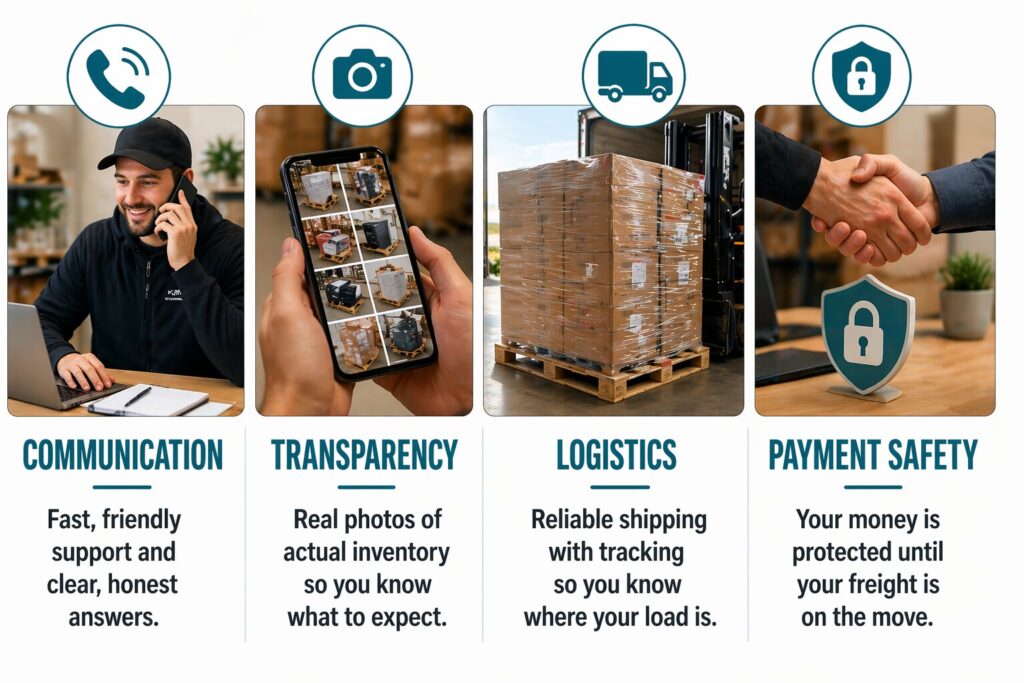
Forget “best supplier” lists. These are the criteria that protect your money.
Condition Disclosure
No supplier can promise that every item on a pallet will be perfect. But they should tell you what the typical condition breakdown looks like for the type of pallet you’re buying.
Walmart pallets can include:
- Shelf pulls (never sold, still in packaging)
- Customer returns (opened, possibly used)
- Clearance items (seasonal or discontinued)
- Damaged packaging (product intact, box crushed)
The mix varies by pallet and by load. A supplier who’s upfront about this before you pay is protecting you from disappointment later.
Refund Policies
This is tricky in liquidation because pallets are sold as-is in most cases. But there’s a difference between “as-is” and “we won’t talk to you if there’s a problem.”
A legitimate supplier has a policy for handling:
- Pallets that arrive significantly different from what was described
- Freight damage that makes the pallet unsellable
- Misrepresented condition or category mix
They won’t refund because you didn’t like the items. But they will work with you if the pallet doesn’t match the description they gave you before the sale.
Worldly Treasures resolves issues when pallets don’t land right. That’s a baseline expectation that isn’t universal in this industry.
Fund Protection
In a standard liquidation purchase, you wire money and wait. If the pallet doesn’t ship, if the supplier goes dark, your money is gone.
Fund protection means your payment isn’t released until freight is confirmed in transit. Worldly Treasures structures every transaction this way. Your capital stays protected until the pallet is actually moving.
If a supplier demands full payment upfront with no protection, understand what that means: you’re carrying all the risk.
Communication
Can you call someone and get a real person? Will they respond to questions the same day? What happens after delivery if you need help?
This isn’t a nice-to-have. When a pallet arrives and something’s off, communication speed is the difference between a resolved issue and a total loss.
Worldly Treasures guarantees same-day communication. That matters more than you think until you’ve dealt with a supplier who ghosts you after taking your money.
Freight Handling
Your supplier should give you FOB location, pallet dimensions, and weight so you can get accurate freight quotes before buying. LTL (less than truckload) shipping is expensive, and if you don’t factor it into your total cost upfront, the math on your resale margins falls apart fast.
Best Supplier Options by Buyer Type
If You’re Buying Your First Walmart Pallet
The biggest mistake new buyers make is assuming all Walmart pallets look the same. They don’t. The condition spread, category mix, and per-item resale value vary wildly depending on where the pallet came from and how many times it’s been repackaged.
You need a supplier who will explain the differences before you spend money. Worldly Treasures works with first-time buyers and walks them through what to expect from each pallet type before purchase.
Skip: Random pallet sellers on Facebook Marketplace or Craigslist. The authentication risk is highest with individual sellers who have no long-term accountability.
If You Run a Bin Store
Bin stores need volume and consistency. One good pallet doesn’t solve anything if you can’t get another one behind it next week.
Walmart general merchandise pallets work well for bin stores because of the category breadth. You get toys, housewares, electronics accessories, seasonal items, and small appliances in a single pallet. That variety keeps bins rotating without requiring you to source from five different suppliers.
But pallets are a supplement, not a primary strategy. Most bin store operators start with pallets and scale to Walmart truckloads once cash flow supports it. The per-unit economics are just better at truckload level.
Worldly Treasures sells both WLMT pallets and WLMT truckloads, which means you can start small and scale up with the same supplier. That continuity matters.
If You Sell on Facebook Marketplace or eBay
Match the pallet type to your selling strategy.
General merchandise pallets give you a range of individual items to list at different price points. Higher-value pieces (small appliances, tools, electronics accessories) drive sales. Lower-value items (housewares, toys, seasonal decor) fill in the gaps.
Clothing pallets require a different workflow. You’re selling volume, not individual premium items. Poshmark, Mercari, and eBay clothing categories are where Walmart apparel moves fastest, but you need space to sort by size and season, and you need patience because clothing sells slower than hard goods.
A supplier who understands your platform can help you pick the right pallet type. Worldly Treasures works with resellers across all channels and knows which pallet types fit which business models.
If You’re Testing Before Scaling to Truckloads
This is one of the smartest uses of pallet buying. Before you commit thousands to a full truckload from a new supplier, buy a couple of pallets first.
You’ll learn:
- How they communicate
- Whether the merchandise matches their description
- How freight gets handled
- What happens if there’s a problem
If the pallets are good, scale up. If they’re not, you’ve only lost a few hundred dollars instead of a few thousand.
Pallets let you test suppliers with minimal financial exposure.
If You’re Buying for Flea Markets or Swap Meets
Walmart pallets are popular with flea market vendors because the merchandise is recognizable and priced low enough to move volume. Customers know the brands. They trust the quality. And they’re used to seeing Walmart items discounted.
The challenge is processing speed. A flea market setup doesn’t give you weeks to sort and price. You need inventory you can unload, clean up, and price fast enough to have tables ready by the weekend.
General merchandise pallets with a broad category mix work well for this.
Worldly Treasures sells pallets to flea market vendors and understands the time constraints that come with that business model.
Common Mistakes Buyers Make With This Store’s Inventory
Confusing Pallets with Truckloads
A pallet is a single unit pulled from a larger load. A truckload is 24 to 26 pallets shipped together. The pricing, the condition risk, and the per-unit economics are completely different.
Pallets cost more per unit because someone has already broken the truckload down and is selling individual pieces. You’re paying for convenience and lower upfront commitment, but you’re giving up margin.
If your business can handle truckload volume, buying pallets long-term is leaving money on the table.
Overtrusting Manifests
Manifested pallets sound safer than unmanifested pallets. In theory, they are. In practice, manifests can be misleading.
A manifest lists items and estimated retail values, but it doesn’t tell you:
- Actual item condition
- Whether high-value items have been removed
- How accurately the retail value reflects real resale pricing
Manifests are useful. They’re just not a guarantee.
Unmanifested pallets from a trusted supplier who’s honest about category mix and condition can be a better buy than a manifested pallet from a broker you don’t know.
Ignoring Freight Costs
LTL freight is expensive relative to what you’re buying. A single pallet shipped 1,000 miles can cost $150 to $300 depending on weight and carrier.
If you’re not getting freight quotes before committing to a pallet purchase, you’re guessing at your total cost. And in liquidation, where margins are thin to begin with, guessing is how you lose money.
Always calculate landed cost: pallet price + freight. That’s your real investment.
Chasing Brand Names
Walmart carries recognizable brands, and new buyers often assume that brand presence equals resale value. It doesn’t.
A pallet with 10 brand-name items and 40 generic items is still a generic pallet. The brand items might move faster, but the bulk of your revenue comes from turning the entire pallet, not just the hero pieces.
Experienced buyers calculate margins based on average per-item value across the whole pallet, not best-case value on the top items.
Choosing a Supplier Based on Price Alone
The cheapest Walmart pallet on the market is cheap for a reason. It’s been processed and picked through, the condition is worse than described, or the supplier has no accountability if things don’t match.
A pallet from a supplier with fund protection, same-day communication, and a track record of resolving issues is almost always a better buy than a cheaper pallet from someone you can’t reach after delivery.
Pay slightly more for reliability. It saves money in the long run.
Final Guidance + Safe Next Step
Walmart pallets are one of the most accessible entry points into the liquidation business. The per-pallet investment is low. The merchandise is recognizable. And the resale channels are well-established.
But accessibility doesn’t mean simplicity. The condition spread is wide. The category mix is unpredictable. And the pallet market is full of suppliers selling picked-through inventory at prices that don’t reflect what’s actually on the truck.
The difference between a profitable pallet and a waste of money usually comes down to sourcing. Where did the pallet come from? How many hands has it passed through? And can the supplier prove it?
Ask those questions before you spend. A supplier who can answer them honestly is worth paying more for.
Have questions? Talk to Worldly Treasures Today
Frequently Asked Questions
Can I buy Walmart liquidation pallets directly from Walmart?
No. Walmart doesn’t sell pallets to individual buyers. They route liquidation inventory through authorized channels. The official marketplace is Walmart Liquidation Auctions on B-Stock, where you can bid on pallets that ship from Walmart distribution centers. Outside of that, authorized liquidation companies purchase Walmart inventory in bulk and sell it to resellers at quoted prices. That’s the most direct access available for pallet buyers.
How do I know if a Walmart pallet has been picked through?
There’s no guaranteed way to tell, but warning signs include: shrink wrap that looks reapplied rather than original warehouse wrap, unusually narrow category mix with no higher-value items, pricing that’s significantly below market for Walmart merchandise, and a supplier who can’t or won’t tell you where the pallet originated. The best protection is buying from a supplier close to the source who has a track record of accountability.
Should I start with pallets or go straight to truckloads?
If you’re new to liquidation or testing a supplier for the first time, pallets make sense. The financial commitment is lower, and you learn how to process and sell liquidation merchandise without risking thousands upfront. Once you’ve proven the model works for your business, truckloads give you better per-unit pricing and lower cherry-picking risk. Most serious resellers eventually scale from pallets to truckloads.
How much does freight cost for a single pallet?
LTL (less than truckload) freight for a single pallet will depend on distance, weight, and carrier. The further the pallet ships, the higher the cost. Always get a freight quote before committing to a pallet purchase so you can calculate your total landed cost. Freight can represent a chunk of your total investment on a single pallet, which affects your margin math.
